
Minion Router vs Nighthawk RAXE300: Specs & Value
The Nighthawk RAXE300 is a larger eight-stream AXE7800 router with six hidden antennas, six Ethernet ports and USB-C storage. Kevin is a compact AXE5400 router with a 2.5GbE WAN, local browser management and a lower entry price. No independent RTINGS test was found for the RAXE300, so this guide separates documented hardware from unproven performance claims.
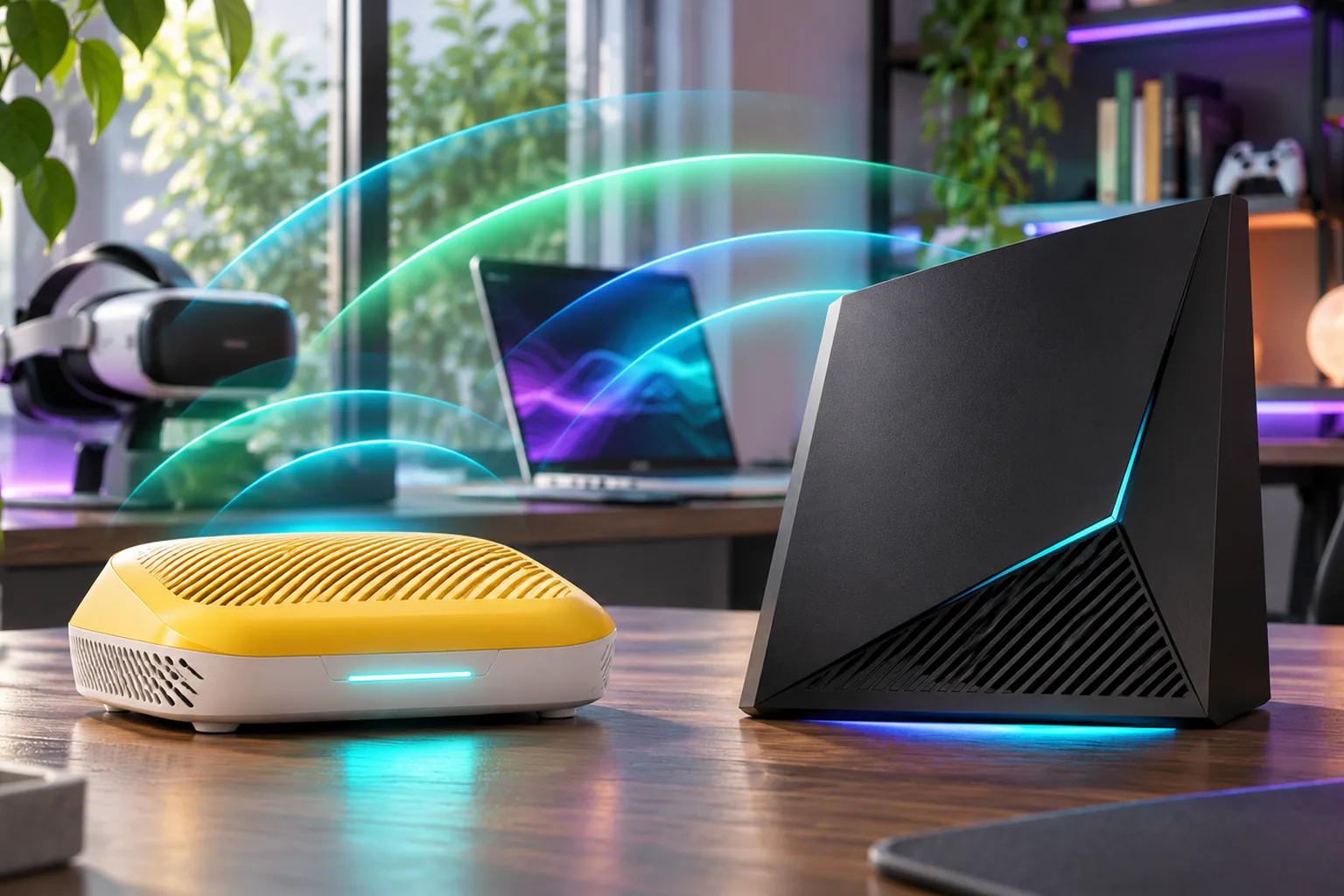
Which router should most buyers choose?
The RAXE300 is the broader wired and software package. It combines a configurable 2.5G/1G port with five additional gigabit ports, USB 3.0 Type-C storage, six hidden antennas and the Nighthawk app. Kevin is the leaner, lower-cost route to 6 GHz, a 2.5GbE WAN and direct local administration.
| Decision factor | Minions Kevin | Nighthawk RAXE300 |
|---|---|---|
| Wireless class | AXE5400 tri-band Wi-Fi 6E | AXE7800 tri-band Wi-Fi 6E |
| Radio streams | Not documented as an eight-stream design | 8 streams, including 4x4 on 5 GHz |
| Antennas | 3 internal antennas, according to RTINGS | 6 internal hidden antennas |
| Ethernet | One 2.5GbE WAN and one 1Gbps LAN | One 2.5G/1G flexible port and five 1Gbps ports |
| USB | None documented | One USB 3.0 Type-C port |
| Management | Local browser interface | Nighthawk app, with browser setup requirements |
| Starting price here | $102.99 for one Kevin | Verify current NETGEAR retailer price |
| Best fit | Lower-cost PCVR and local control | Wired desk, storage and larger feature set |
Specifications come from NETGEAR's official RAXE300 data sheet and RTINGS's Kevin review, checked 2026-11-03. This page does not claim an independent speed or range winner.
What are the Nighthawk RAXE300 specifications?
NETGEAR rates the RAXE300 as an AXE7800 tri-band Wi-Fi 6E router with 600Mbps on 2.4 GHz, 4.8Gbps on 5 GHz and 2.4Gbps on 6 GHz. The data sheet lists eight streams, a 1.7GHz quad-core processor, six hidden antennas and one USB 3.0 Type-C port for network storage.
| Specification | Nighthawk RAXE300 |
|---|---|
| Wireless class | AXE7800 tri-band Wi-Fi 6E |
| Bands | 2.4, 5 and 6 GHz |
| Streams | 8 total: 2x2 on 2.4 GHz, 4x4 on 5 GHz and 2x2 on 6 GHz |
| Rated rates | 600Mbps + 4.8Gbps + 2.4Gbps |
| Processor | 1.7GHz quad-core |
| Antennas | Six hidden high-performance antennas |
| Ethernet | One 2.5G/1G flexible port and five 1Gbps ports |
| USB | One USB 3.0 Type-C port |
| Security | WPA3, VPN, guest network and firewall |
| Subscription features | Armor included for one year and parental-control premium after a trial |
NETGEAR says either the 2.5G/1G port or the 1G Internet port can connect to the modem, but they cannot both be used for Internet at the same time. The data sheet also says two gigabit LAN ports can be aggregated for a compatible device. Verify current regional features on the official RAXE300 data sheet.
What does the Minions Kevin provide?
Kevin is a tri-band AXE5400 Wi-Fi 6E router. RTINGS documents three internal antennas, one 2.5Gbps WAN port, one 1Gbps LAN port and up to seven SSIDs per band. It supports local browser administration and compatible Davolink Minions mesh hardware.
- Wi-Fi 6E on 2.4, 5 and 6 GHz
- 2.5GbE WAN for compatible multi-gig internet
- One gigabit LAN for a gaming PC or console
- Local browser interface
- Per-band SSID controls documented by RTINGS
- Compact upright body and compatible Minions mesh
Use the Kevin specs for the complete hardware sheet and the review for the buyer-facing trade-offs.
Is AXE7800 faster than AXE5400 in real life?
The AXE7800 and AXE5400 labels are combined maximum radio rates, not the speed one phone, laptop or headset will receive. The RAXE300's larger 5 GHz configuration and eight-stream design may improve capacity for compatible clients, but the benefit depends on the client and the environment.
| Question | What the evidence supports |
|---|---|
| Does RAXE300 have the higher headline rating? | Yes. NETGEAR rates it at AXE7800 versus Kevin's AXE5400 class. |
| Does that prove faster everyday downloads? | No. A single client may not be able to use the extra radio streams. |
| Does RAXE300 have more 5 GHz streams? | Yes. NETGEAR documents 4x4 on 5 GHz. |
| Does RAXE300 have a measured range advantage? | Not established here. No independent RTINGS RAXE300 review was found. |
| Do both provide 6 GHz? | Yes. Both are tri-band Wi-Fi 6E, not Wi-Fi 7. |
Buy the larger radio for a known capacity need or a compatible multi-user workload. Do not assume that the larger number on the box will double a Quest 3, phone or laptop's throughput.
Which router has better wired networking?
The RAXE300 is clearly the larger wired package. It offers one 2.5G/1G configurable port plus five 1Gbps Ethernet ports, and NETGEAR documents link aggregation for two gigabit LAN ports. Kevin provides only one 2.5GbE WAN and one gigabit LAN.
| Wired need | Better fit | Reason |
|---|---|---|
| Multi-gig internet | Either | Both document a 2.5G-capable WAN path |
| PC, console, NAS and more | RAXE300 | Five additional gigabit ports |
| USB storage | RAXE300 | USB 3.0 Type-C port |
| Port aggregation | RAXE300 | Two gigabit LAN ports can be aggregated with a compatible device |
| One wired PC for PCVR | Kevin | The single LAN port is enough for the basic topology |
| Lowest hardware cost | Kevin | This store lists the single router from $102.99 |
On the RAXE300, only one Internet port is used for the modem connection at a time. Do not count the flexible 2.5G/1G port twice when planning the number of downstream devices.
What can we conclude about speed and range?
We can compare documented radios, streams, ports and features, but not declare a winner from real-world speed or range. NETGEAR makes performance claims for the RAXE300, and RTINGS has a published 7.8/10 Kevin review with impressive nearby 5 and 6 GHz speed. The two data sources are not equivalent measurements.
- Treat AXE7800 and AXE5400 as specification classes, not guaranteed client throughput
- Treat NETGEAR's range and latency descriptions as manufacturer claims
- Use RTINGS's Kevin result only for Kevin, not as a direct comparison with an untested RAXE300
- Test your room, walls and client before assuming the larger radio automatically reaches farther
An independent RAXE300 benchmark was not available in the sources checked for this page. This is a deliberate evidence limit, not an implied result in either router's favor.
How do app controls, security and subscriptions compare?
The RAXE300 includes the Nighthawk app, VPN support, guest networking, WPA3, automatic firmware updates, Armor for one year and Smart Parental Controls with a premium tier after a trial. Kevin uses a local browser interface and documented per-band SSIDs, which is simpler for someone who wants direct network administration.
| Feature | Minions Kevin | Nighthawk RAXE300 |
|---|---|---|
| Primary management | Local browser interface | Nighthawk app |
| Guest network | Supported through separate SSIDs | Documented guest network |
| VPN features | Check current Kevin firmware | Client/server access documented by NETGEAR |
| Security | WPA3 | WPA3, firewall and Armor |
| Parental controls | Check current firmware | Smart Parental Controls; premium features require a subscription |
| Remote management | Not a documented strength | Nighthawk app supports access away from home |
Include subscription cost and regional availability when comparing the total price. For Kevin's local network setup, see the guest-network guide and admin login guide.
How does mesh expansion compare?
Kevin can expand with compatible Davolink Minions units in two- and three-packs sold on this site. The RAXE300 is a standalone Nighthawk router; buyers should verify the current NETGEAR mesh or compatible extender path before assuming it will join a whole-home system.
- Choose a Kevin kit when a matching Davolink mesh is already planned
- Choose the RAXE300 when its Ethernet, USB and radio capacity solve the problem in one location
- Do not assume that routers from different brands can form one proprietary mesh
- Place mesh nodes and routers by measured signal, especially in multi-floor homes
Read the Minion mesh guide, range guide and Wi-Fi extender guide before adding a second network device.
Which is better for Quest 3 and wireless PCVR?
Kevin is the lower-cost, more focused PCVR starting point. A nearby 6 GHz band pairs with one wired LAN port for the gaming PC, and RTINGS documents strong nearby 5 and 6 GHz speed. The RAXE300 provides a comparable 2x2 6 GHz radio, a faster 5 GHz radio and much more wired capacity, but its actual PCVR latency has not been independently measured here.
- Wire the gaming PC to either router
- Keep the headset on a dedicated 6 GHz SSID where supported
- Test sustained latency and jitter in the play area
- Choose Kevin when the network is simple and the lower price matters
- Choose RAXE300 when one router must also support several wired devices and USB storage
Follow the Quest 3 router guide for the complete headset and PC setup.
Which router is the better value?
Kevin starts at $102.99 for one unit on this site. The RAXE300 is a larger router with more Ethernet, USB and software features, so its current retail price must be compared against the full job. A cheap router that requires a switch is not cheaper if the switch is part of the requirement.
| Budget consideration | Comparison |
|---|---|
| One nearby 6E client and one wired PC | Kevin usually covers the need with fewer extras |
| Several wired devices and USB storage | RAXE300 may replace a switch and storage accessory |
| Large home coverage | Compare a Kevin mesh kit with any RAXE300 plus extender or mesh path |
| Premium security features | RAXE300 includes Armor for one year; check renewal pricing |
| Parental controls | RAXE300 premium features require a subscription after the trial |
Check current Kevin kit prices and verify the live NETGEAR price plus subscription needs before ordering.
Who should buy each router?
| Buyer | Better choice | Why |
|---|---|---|
| Compact, lower-cost PCVR setup | Kevin | Nearby 6 GHz performance, one LAN and a lower starting price |
| Wired-heavy desk | RAXE300 | Six Ethernet ports, subject to how one is used for Internet |
| USB network storage | RAXE300 | USB 3.0 Type-C port |
| Local browser administration | Kevin | Direct local interface |
| Larger 5 GHz capacity | RAXE300 | Official 4x4 5 GHz and eight-stream design |
| Existing Davolink Minions mesh | Kevin | Compatible mesh ecosystem |
The RAXE300 is the more expandable single-router package. Kevin is the better value when the network is small and the main job is a nearby Wi-Fi 6E client with a wired PC.
Key takeaways
- Both routers are tri-band Wi-Fi 6E rather than Wi-Fi 7
- RAXE300 is rated AXE7800 with eight streams; Kevin is AXE5400-class
- RAXE300 provides six Ethernet ports and USB 3.0 Type-C; Kevin provides two Ethernet ports and no documented USB
- Kevin is the lower-cost, more compact nearby-PCVR choice
- No independent RTINGS RAXE300 review was found, so this page does not claim a measured speed or range winner
For a mesh system with more coverage, compare Kevin vs Deco XE5300. For another standalone router with USB and AiMesh, read Kevin vs ASUS RT-AXE7800. Compare every finalist in the Minion Router alternatives guide.
Frequently asked questions
Is the Minion Router better than the Nighthawk RAXE300?
Kevin is better for the lower entry price, compact PCVR setup and local browser management. The RAXE300 is better for more Ethernet ports, USB-C storage, a larger 5 GHz radio configuration and the Nighthawk app ecosystem.
Do both routers support Wi-Fi 6E?
Yes. Kevin and the Nighthawk RAXE300 both provide tri-band Wi-Fi on 2.4, 5 and 6 GHz. Neither offers Wi-Fi 7.
Is AXE7800 faster than AXE5400?
AXE7800 is the higher combined radio rating, but it does not guarantee higher throughput for one device. Client support, streams, distance and interference determine real speed. No independent RAXE300 measurement was used to claim a direct performance winner.
How many Ethernet ports does the RAXE300 have?
NETGEAR documents one 2.5G/1G configurable port plus five 1Gbps Ethernet ports. One of the gigabit ports is also configurable for Internet or LAN, and both Internet options cannot be used for the modem at the same time.
Does the Nighthawk RAXE300 have USB?
Yes. NETGEAR lists one USB 3.0 Type-C port for network storage. Kevin's documented hardware does not include a USB port.
Which is better for Quest 3 PCVR?
Kevin is the clearer lower-cost nearby-PCVR choice because it has 6 GHz, a wired LAN and RTINGS-documented nearby speed. The RAXE300 has more room-filling hardware and wired capacity, but its independent PCVR latency was not established for this comparison.
Need a compact nearby 6E router?
Minions Kevin starts at $102.99 with Wi-Fi 6E, a 2.5GbE WAN and local browser controls.